Friday, October 27, 2006

The Boys...

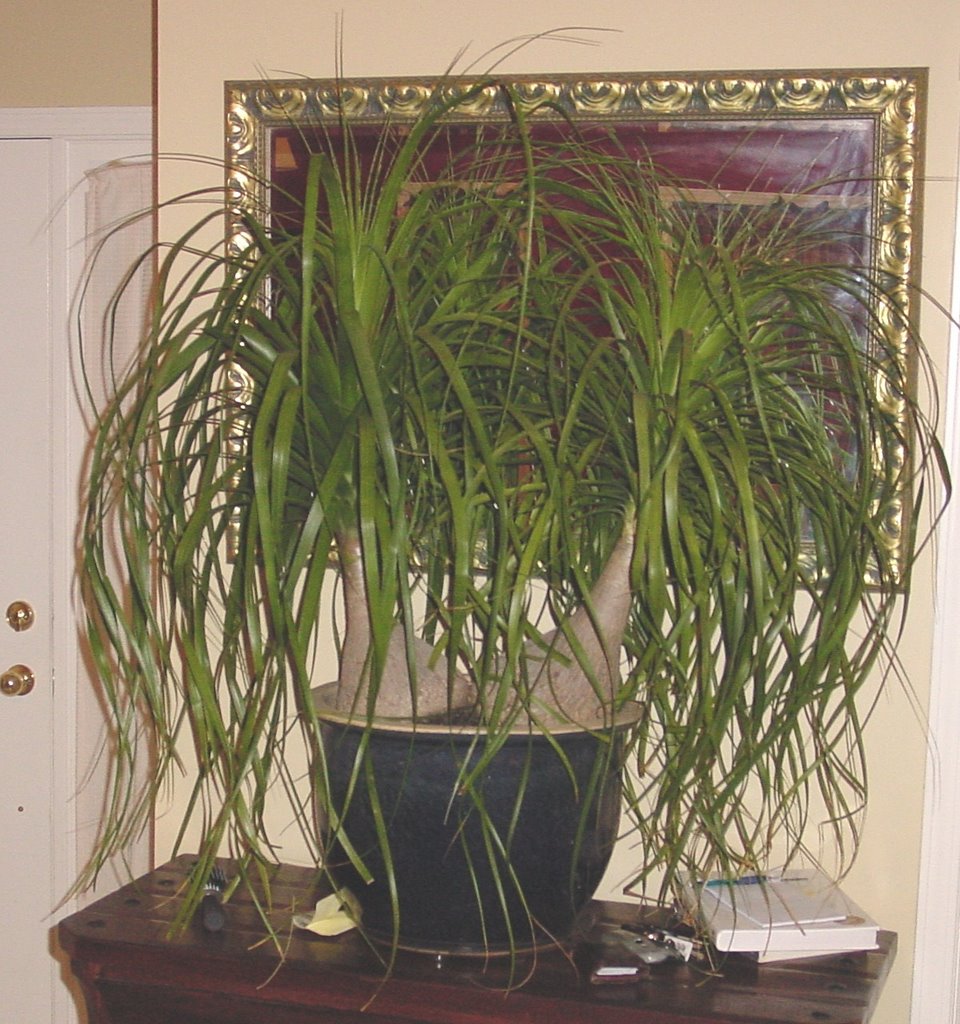
Hey. Remember back... oh, two and a half years ago when I told you about Mike. Yeah, you know, Mike the Dracaena Marginata (Not, apparently Draco) plant who lives in my house. Anyway, it seems apparent that he's impossible to kill. He comes to mind as worth recording something about now since he recently came inside for the winter. At 7 feet tall and standing in our living room he comes to mind quite a bit.


So indeed, that's Mike. Now celebrating about 18 years in the family more or less. No way to be sure with my lousy recollections.


Now lest some other persons in the family get jealous it's probably wise if I also introduce Paul as well. Paul, like Mike, has been around for about 18 years and also started out in one of those tiny little 3-inch pots. Now Paul does me the grand favor of breaking his ever-growing pot about once a year.


This year when I brought him inside for the winter my wife was absolutely THRILLED to discover that a family of moles had burrowed their way into the pot and were actually LIVING in Paul's root ball. I'm pretty sure I'll never hear the end of that...

Thursday, October 26, 2006

The Bench: Take 2

Well, it’s that time of year again; yes, that time of year when my wife asks for a bench and I somehow manage to build something else. See, the instructions were pretty simple this time. She asked for a bench… well, specifically, this bench. Simple enough, right? Well, apparently not.

All was going just swimmingly until one fateful night when she came out to the garage as I was working on the ‘bench’ and uttered those fateful words: “Man, this thing sure is big.” That, my politely quiet reader, was the beginning of the end. After a bit of quick checking it seems I’d completely hosed the dimensions on the desired bench. Yes, that’s right. The bench SHE wanted would fit very neatly and very precisely into the open space on my version. Indeed it was about 8 inches too tall. After the fact it was all very obvious but before the fact… well, no so.

At any rate, it now makes a pretty tidy… well, something. Not quite a window seat (unless you’re 7 foot 4) but not quite just a bookshelf. But it’s useful and was not an utter and complete waste of wood in any case. Just mostly.


Total cost of this project with wood, primer, and paint: $80.


Wednesday, September 27, 2006

The Bible - Genesis - Chapter 32: Jacob’s Fear of Esau

Leaving Laban, Jacob travels to the land of his brother Esau. Rightfully concerned that Esau might still be a bit miffed at him he takes a few precautions. Jacob sends messengers to Esau announcing his presence and indicating his status as a man with large flocks of both animals and servants. Disappointingly, the messengers return with word that Esau and 400 of his men (probably with brass knuckles) are on their way to meet him. For the first time in a while, Jacob turns to the Lord and utters a lengthy prayer to ask for protection against the mob and to remind God of his promises from Chapter 28. Still hedging his bets and doubting even God’s protection, Jacob divides his household so that half might escape if the other half is attached. To cover all possible bases he also sends a large gift of livestock to his brother.

Having made his preparations, Jacob is left alone to await his fate. According to the NASB, God (anthropomorphic as usual) comes to Jacob and they wrestle. After many hours of wrestling, God lets Jacob win and grants him his blessing. The JSB differs on this episode in almost every possible regard. It fails to identify the mysterious wrestler as anything but a ‘supernatural being’ and admits to no ‘blessing’ being received at the end of the contest; the stranger simply leaves. The two do agree in that the stranger gives Jacob a new name, ‘Israel’, and Jacob rejoices that he’s survived this contest and infers that his survival must indicate some sort of divine blessing.

Whichever the case, the idea that Jacob, this worm of a man, should receive the blessing of the Lord is appalling. His short history in Genesis shows him to be a devious, self-serving little weasel who only bothers to pray when he needs something. As usual, God’s chosen ones don’t exactly distinguish themselves positively from the people around them.

The Qur'an - Al-Fatihah: The Opening

This opening chapter is, according to the commentary, the very summation of the whole of Islam. It is only seven verses but amusingly results in four full pages of text in the notes. Since it is that important, I will quote the seven lines here:

1 Praise be to Allah, the Lord of the worlds,
2 The Beneficent, the Merciful,
3 Master of the day of Requital.
4 Thee do we serve and Thee do we beseech for help.
5 Guide us on the right path,
6 The path of those upon whom Thou has bestowed favours,
7 Not those upon whom wrath is brought down, nor those who go astray.

Verse 1: From the notes, the description of Allah as ‘Lord’ is not in the sense that we would use it. Instead it indicates Allah as one who nourishes his people until they attain perfection. This seems to parallel the ‘shepherd’ image sometimes used for Jesus. By ‘worlds’ we appear to mean the nations or people of the world (not just the Muslims.)

Verse 3: The word here translated as ‘day’ is actually one that refers to any indefinite period of time. The author indicates this is indicative of the ongoing judgment of man, punishment of evil and reward of goodness that goes on around us all the time. The Requital seems to parallel closely the ‘Judgment Day’ of Christian religion.

Verse 4: Through humility and obedience to God, the followers will receive divine assistance in their daily lives.

Verse 6: Later we are apparently told who has favors bestowed upon them: the prophets themselves, the righteous, the truthful and the faithful. It is my hope that these groups are actually defined more specifically later.

Verse 7: Don’t screw up or you may still go to hell. The notes here are revealing. Among those who ‘go astray’ are the Jews and the Christians: the Jews because they refuse to believe in Jesus as a prophet and the Christians because they elevate a prophet to the status of God. Muslims are warned to tread the middle path and do good works as well as keeping the doctrine free of any corruption.

The summary seems simple and familiar: I am the one true god; I am merciful and good. Beware for a day of judgment will befall you and you shall reap what you have sown in life. Simple enough.

Tuesday, September 26, 2006

Books While I was Dead

While I was dead recently I did take the opportunity to blow through a few random books from the ever-increasing book backlog. While I don’t have an ocean of words just pressing against the inside of my head waiting to get out in this vein I’d consider it a disservice to myself if I didn’t at least put down in some form my immediate thoughts on what I’ve recently tickled myself with.

The War of the Worlds, H. G. Wells - Over the years, I’ve read this tiny thing at least a dozen times and as usual, it lived up to my expectations though after this many readings it’s not nearly as dramatic as it was the first eleven times. Well worth missing an evening of network television for even if it was the 112th time.

Cousin Henry, Trollope - Yeah, I admit it, I’ve read a bit of Trollope. You don’t read Trollope for any of the good reasons you’re supposed to read things. You read Trollope because it’s just damn entertaining. In the literary world, this is the equivalent of the daytime soaps but the antiquated setting and verbiage makes it somehow much more satisfying. So yeah. I read Trollope. You wanna make somethin’ of it? On Cousin Henry specifically I’ll say that this is one of the best of Trollope’s works. I can still see the little worm sitting in the library staring at the book that holds the missing will. *sigh*

Brave New World, Huxley - Somehow in my upbringing I missed Huxley’s Brave New World. I’m honestly not sure how as it’s much more striking than Orwell’s 1984 so I regret the years I’ve lived without its influence. Well, without its direct influence anyway. I think we all suffer from it in a way as our world creeps ever closer to that of Huxley’s imaginings.

Alexander’s Bridge, Cather - One of the gifts and curses of having the pending reading queue right outside in the garage is the ability to grab any old thing at random and sit down and read it. Alexander’s Bridge was one of these cases but I’m hard pressed to determine whether this one was a gift or a curse. I’d categorize this as an OK first novel; it’s clearly better than my first novel.

The Riddle of the Sands, Childers - This little ditty was much more firmly entrenched in the ‘curse’ category. Written in 1903, this is purported to be one of the progenitors of the modern spy novel. Unfortunately, the plot was so laden down with nautical jargon, maps of sand bars and hopeless specifics that it was hard to keep one’s eyes open. Still, not a bad idea as plots go but filled with fluff.

Lady Audley’s Secret, Braddon - Did you ever read a book and have this creeping sense that you’d read it before? I still cannot identify WHEN I would have read this but when George Talboys disappears my mind went immediately to the well, even before it was mentioned. I must have been a warped child to have read such a thing long enough ago to have forgotten it so completely. At any rate, a pretty decent way to spend a couple days, especially if you don’t know about the deal with the well. Er… did I say well? I meant … storm at sea, yeah, he’s lost at sea. That’s it.

Gulliver’s Travels, Swift - For some reason this book reminds of Swiss Family Robinson. Well, actually, there’s at least one obvious reasons it might. There’s the whole shipwreck motif of course but in addition there’s this grand dichotomy of what the book REALLY is and what most people think of when you mention the book. With the Family Robinson people think of it as a ripping family adventure yarn but actually it’s a veiled religious diatribe and encyclopedia of misinformation on the botany and zoology of the tropics. Gulliver’s Travels conjures images of fantastic creatures and far-away lands for most people but if you actually read the thing it’s one long political cartoon. I will say that the book is clearly deserving of its status as a classic but it’s difficult to appreciate without knowing a bit about the political systems of the time to understand exactly who Swift is poking fun at in such a pointed manner. This gives one the idea what Doonesbury will be like in another 100 years when all the main characters are long dead and mostly forgotten.

The Natural, Malamud - Yeah, we’ve all seen the movie. Fortunately, it doesn’t really have a whole lot of similarity to the book. Poor Roy Hobbs … but what do you expect when you take a bribe and throw the game and there are only five pages left?

Soul of the Sword, O’Connell - Alright, at last some non-fiction you’re surely saying. O’Connell in his smallish tome traces the history of human weaponry from sticks to ICBMs. As an overview, it’s not bad and gives some interesting historical side notes but for my taste it lingers over long on the more modern side of things. It seems to spend half its contents blathering about the development of the gun and while I realize the gun is the single most important weapon in the history of civilization we needn’t have given it that much attention.

Gaskel, Cranford - This one is amusingly plot free but an interesting snapshot of life in Victorian (1837-1901) England.

The Prime of Miss Jean Brodie, Sparks - Another random selection that was clearly more of a curse than a gift. Not a bad concept for a novel (teacher corrupts students into her servitude even into their adulthood) but somehow dull despite that. Oh well.

Monday, September 25, 2006

Dead or Alive

Recently I realized that it had been two solid months since I’d posted anything at all meaningful here. More correctly some would say that it’s been several years since I posted anything meaningful but let’s loosen our definition for the sake of current argument. Since that time, I’ve wandered my way through eight books and started a couple of others, had at least one annoying medical procedure and done countless other things that I’ve completely forgotten about, mostly because I’ve not written them down. It may be officially time to start this personal fad again.

I think I’ll resume the Bible and the Qur’an just for the halibut. I’ll repost those lost Qur’an entries from bygone days and just pick up with chapter 32 of Genesis. Hopefully the reading list won’t suffer unduly. Other projects include a reading-related attempt to remember some semi-random factoids such as the history of the British Monarchy and a few other key dates from history so forgive me if I randomly interject the occasional non sequitur of the form “Elizabeth I, 1558 through 1603” into every third post or so. I’m also thinking it might be good to be able to rattle off chapter and verse from a few key Bible passages. It seems a lot of effort though for little actual return though. At any rate, I’m awake again.

Oh! Since I’ve already forgotten, I’m also working on increasing my rather vacuous vocabulary. Primarily, it’s just to augment my alliterative abilities but do forgive me if I spend twenty minutes trying to find a way to fit the word denouement into the description of a Bible chapter or two… (Don’t you just love the specificity of some English words? Especially those we steal from other languages.)

The Qur'an - Introduction

The following entry represents my notes and observations as I read ‘The Holy Qur’an with English Translation and Commentary’ by Maulana Muhammed Ali. At times, the Qur’an is pointedly opinionated towards certain people and groups. I will repeat the Qur’an’s opinion as I understand it based on the text but in no way should this be construed as my own opinion about any group or individual. Any person who differs with my interpretation is invited to comment including specifics and I’ll be happy to reexamine the passage(s) at issue. Lastly and most importantly, none of the views herein expressed should be construed a criticism of the Qur’an or the Islamic faith. I hold both in the highest possible regard and it is because of this than I seek to know more about both.

Introduction

The introduction is almost 70 pages and as it spends most of it’s time trying to convince the reader of the superiority of Islam I will not attempt to annotate it in its entirety but instead summarize the ideas contained therein.


The Qur’an is divided into 114 chapters or surah (literally, a step in a structure or building). The entire text of the Qur’an was revealed to the prophet Muhammad over the period of 23 years and taken down in excruciating detail by his followers. The text was not simply dictated from beginning to end but piecemeal over that period of time and later arranged under the supervision of the prophet himself.


After the initial discussions of origin, the author goes on to describe the ultimate triumph of Islam over all other world religions and the unparalleled ‘civilizing’ effect it has had on the nations of the Middle East. He also points out that it is considered to be the very epitome of Arabic style and diction. All other Arabic literature is judged against the Qur’an from a literary standpoint and the author goes on to say that the Qur’an has single-handedly kept the language of Arabic alive throughout the centuries.


Most highly offensive to Christians, perhaps, the author states emphatically that the Qur’an contains a ‘corrected’ version of Biblical events. Based on the author’s interpretation, the Qur’an is the ‘Guardian’ of previous scriptures and gives a true representation of the events which the Bible describes. It openly acknowledges that other prophets were sent by God (including Jesus) but states that their message has been corrupted by the man.


On the topics of Heaven and Hell, the Qur’an seems to parallel classical Christian belief. Heaven as described by the author is not an end, however, as Christianity might have you believe. Apparently there’s work to be done in Heaven and the Lord will keep you busy once you arrive. Also contrary to Christian belief, Hell is not eternal. Hell is intended to prepare the soul for the work of Allah and as such does not last forever. After an appropriate period even the most evil of souls are elevated to Heavenly status. Lastly on this point comes the concept that Heaven and Hell do not merely begin at the time of death. Those who do good reap the benefits of that good while still on this Earth as much as those who do evil.


The introduction also touches on the position of women in society. The author’s interpretation puts women on an equal footing with men with the only restriction being that women and men should ‘restrain their sexual passions.’ Also contrary to popular belief, polygamy is only allowed in the case of widows. In an area of the world often torn by war, this is more of a practical measure than a religious one.

The last section of the introduction describes the oral tradition and those among the prophets entourage who had memorized the entire text of the Qur’an from beginning to end. It is believed that the exact text has been preserved word for word since it was first penned 1400 years ago.

Saturday, August 19, 2006

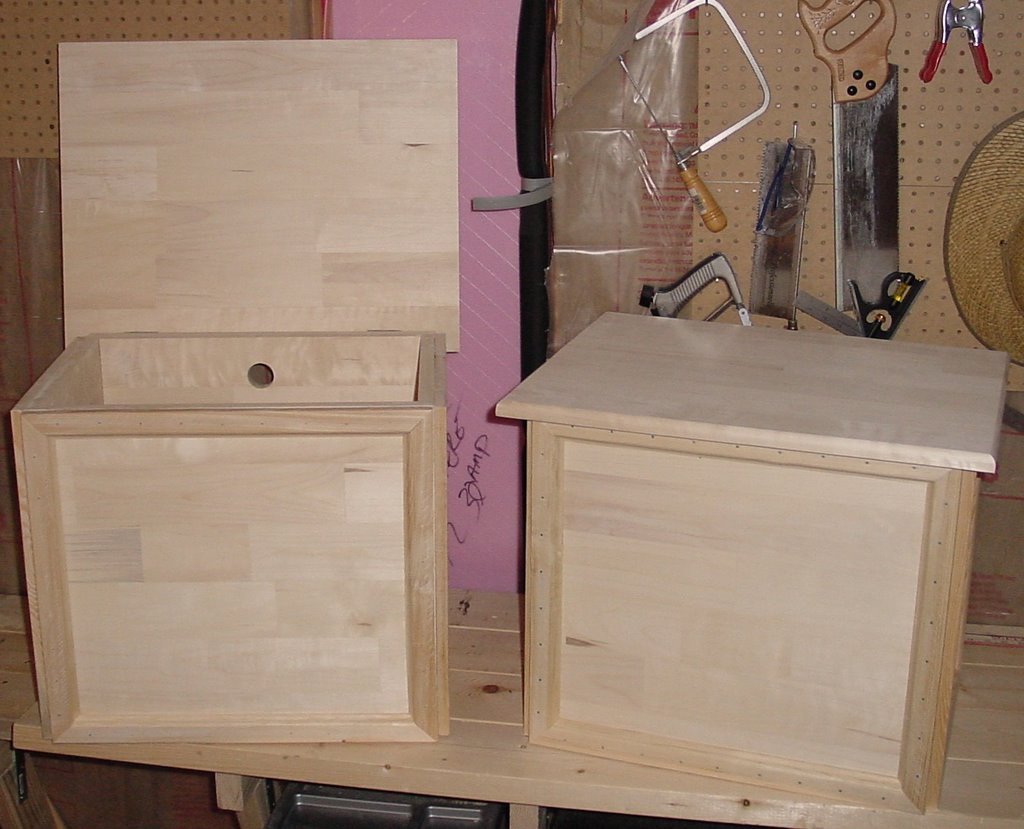
Project: Twin Toy Chests

Well, the first woodworking project since that ‘build me a bench’ fiasco of ’01 is finally complete. The result is a set of twin mini toy chests. Outside dimensions: 18” x 20” x 13.5”. Those measurements were dictated by the size if the extra lumber I had laying around more than any esthetic reason. Sides and top are joined by some VERY uneven rabbet joints and overall the project amounts to two VERY heavy but VERY sturdy hinge-lidded boxes. Kathy plans to finish these with some high-gloss white paint and add a cushion to the top so they can double as extra guest seating when the leprosy clears up in the house and the department of health allows us to have guests again.


Total cost of this project including tools, lumber and hardware: $890. Luckily, I get to keep the tools. Overall, this is almost a good trade for most of the guts of my coin collection. I will say that even though in relative terms this is a very simple project it was a good learning experience. Clearly I need to exercise a bit more patience in some areas but the fact that the wife isn’t revolted beyond sensible words indicates my results were not totally outlandish.

Thursday, August 03, 2006

Genesis - Chapter 8

Wow... looking back, I amuse myself. This almost inspires me to start reading this book again... alright, more than almost.

Chapter 8: The Flood Subsides

After the rain, God suddenly remembered Noah and his animals and passes a wind across the Earth to counteract all that water. The water steadily decreases and five months after all this started, the ark comes to rest in a mountain range in the area of Ararat. Contrary to popular belief, there is no Mount Ararat, the name refers to the ancient country Uratu now occupied by Turkey, Iraq, Armenia and Iran. Three months after it comes to rest in the mountains, the tops of the mountains became visible.

After 40 days, Noah opened the window and sent forth the raven. It “flew here and there until the water was dried up from the earth.” Considering that’s months away, it’s a pretty impressive feat of endurance. He then sends out a dove but it returned as it found no place to land. Noah waited another seven days and sent out the dove again; this time it returned with a fresh olive leaf in its beak. This is surprising given that no olive tree could survive several months under water. Further, the common olive (Olea europaea) can take several months to germinate even in the most optimal circumstances. Add to this the fact that the olive is not a mountain-dwelling plant so the waters must have receded at an incredible pace for there to be an olive leaf available even if it plucked a new sapling tree from the ground.

Noah waited another seven days and sent the dove again. This time it did not return. Deciding after very nearly a year in the ark that it was safe to come out, Noah removes the covering of the ark and at exactly a year from the time they entered the ark the earth is declared dry again. God speaks to Noah and tells him to get out of the ark and bring all the animals forth to repopulate the earth. This is, of course, impossible. Two individuals from a species cannot repopulate the earth for very specific genetic reasons.

After bringing out the animals, Noah builds an altar to the Lord. Then he takes some the extra “clean” animals that the lord commanded him to save in chapter seven, slit their throats and burned their corpses on the altar as an offering to God. It’s funny, I never heard about any of that in Sunday school or those made-for-TV-movies about Genesis. If a person did this today, they would be thrown in jail or burned as a witch. This is exactly the sort of behavior that modern society ascribes to devil-worshipers. God “smelled the soothing aroma” and promised to never again curse the ground because of the acts of man. He goes on to say that “the intent of man’s heart is evil from his youth.”

Frankly, I’m appalled at this chapter. Noah murders animals and burns their corpses and God looks on in apparent glee. Further, he goes on to say directly that man, who he created, is evil from his first days on earth. Any entity that looks at a baby and sees evil yet rejoices in the smell of burning corpses is, frankly, sick. Luckily, for the people who subscribe to this doctrine, all this has been revised and expunged from popular perception of the Bible.

Tuesday, August 01, 2006

The Next Big … Struggle

It should be noted that the following Blog entry is more for my internal reference than for anyone to actually READ it. I like to keep track of the various meanderings that my mind takes but from your perspective it’s of no interest whatsoever. So, read if you like but don’t feel obligated to and don’t say I didn’t warn you.

On June 11th, I declared the 5 big goals of the moment: learn Spanish, write this Blog, do something with the coin collection, finish the Bible and get the outside landscaping done and garage properly cleaned up and organized.

As I open on August 1st, I find a few updates are in order. The Spanish goal is officially dead. After four books, 1000 new additions to my Spanish vocabulary and scores of hours spent on this I return to the fact that there wasn’t any real point to this in the first place. Even if I were completely fluent I’m not sure what I would actually do with this skill. More realistic levels of proficiency leave me only the option of watching REALLY poor quality Spanish television of reading classic Spanish literature for which more accurate English translations already exist.

The Blog goal has foundered somewhat but since I’m writing it now it must not be completely dead. My posts have hovered around a somewhat more pictorial style due to a still-valid theory that the commonplace, everyday visuals of our lives all too soon pass out of the sight of our minds eye. This still strikes me as a valuable, though boring to witness, record-keeping system for the mundane bits of one’s life.

The third item on the list is an item of no small contention. The coin collection represents for me the last example of my urge to collect, to grasp onto meaningless material goods. Starting on the 28th of June, I loosened my grasp by beginning the process of eBaying the whole stinking mess. From a purely numerical perspective, I’m a tiny fraction of the way through but from the standpoint of releasing the ‘suffering’ these coins represent I’m well on my way. The problem with any collection is that it’s a “sink” for resources. Sure, you may enjoy the collection but in the end, the only way to get more enjoyment from it is to contribute more resources to it. Collecting is an infinite spiral of suffering as you grasp for more and more and contribute more and more resources. All the while, you look back and see how much accumulated money you’ve spent and the waste that it represents. The only way to stop the suffering is to reclaim the squandered resources. Thanks to someone out there (you know who you are) who made this obvious truth… obvious.

Number four… ahhh, that illusive number four. The Bible, that most controversial yet most powerful document on the planet. After the past couple days, I find myself strangely motivated again to read this book but not for the reason anyone HOPES you read it. For the first time in a while, I was involved in an argument, an argument with a conservative. There is something eerily powerful about being able to argue with someone using their own source literature against them Well, at least until they claim that their Christian Faith doesn’t actually have its foundations in the Bible. When that happens one must just raise an eyebrow and walk away slowly…

The fifth goal represents… well, it represents a lot of things I’m really not all that great at. Goal number five in its most basic form consists of all the ‘manly’ household arts. The end of goal three has contributed greatly to the advancement of goal five since I now have the free capital to put together a pretty decent woodworking shop. And whereas collecting is a ‘sink’ of resources and energy, woodworking results in actual useful stuff from furniture to lots of miscellaneous items that can be used as Christmas gifts. As an endeavor, goal 5 contributes to the positive karma of the universe while goal 3 merely sucks karma out of the universe.

Unstated even in the June entry is the mystical goal six. Those who’ve been watching for a while will probably guess that this is the ‘reading list’. The Spanish goal effectively killed this goal but since the death of goal 1 I’ve blasted through ‘Brave New World’ and half of ‘Alexander’s Bridge’. Very entertaining pursuits in their own ways and very worth their own Blog entries… eventually.

To summarize, goal 1 is dead; it died a dreadful and pointless death under the weight of its own meaninglessness. Long may goal 1 be dead. Luckily, I have plenty of other goals to fill the void it leaves behind. I’m forced to wonder though… what are the rest of you people doing out there?